Reverse logistics: Learn from your returns
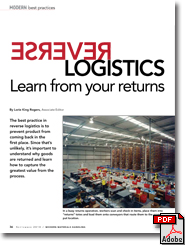
The best practice in reverse logistics is to prevent product from coming back in the first place. Since that’s unlikely, it’s important to understand why goods are returned and learn how to capture the greatest value from the process.
Latest Material Handling News
Registration open for Pack Expo International 2024 Walmart chooses Swisslog AS/RS and software for third milk processing facility NetLogistik partners with Vuzix subsidiary Moviynt to offer mobility solutions for warehouses Lucas Watson appointed CSO for Körber’s Parcel Logistics business in North America Hyster recognizes Dealers of Distinction for 2023 More NewsReverse + logistics = reverse logistics. Sounds like a basic equation, one that would imply that reverse logistics is simply the supply chain moving backward. But if you ask Shibesh Banerji, principal consultant at Tompkins Associates (800-789-1257, www.tompkinsinc.com), he will tell you that the process isn’t so simple. In fact, Banerji and his colleagues prefer the term service supply chain to represent the scope of reverse logistics.
The service supply chain starts the moment a product is sold to a consumer and lasts right up until the end of its useful life, explains Banerji. “There was a time when we would receive a returned item and dump it. Nobody really cared what happened afterward. An OEM or retailer would wash their hands of the item and move forward.”
Not anymore. That practice is changing, and there’s a lot more focus on moving backward. Suppliers and retailers are paying attention to returns whether they like it or not. “Reverse logistics is like a diet—you know it’s good for you, but it’s hard,” says Don Derewecki, assistant vice president at TranSystems (201-368- 0400, www.transystems.com).
See below for related articles
Getting the most from your own pallet pool
UPS introduces new reverse logistics offering

Article Topics
Latest in Materials Handling
Registration open for Pack Expo International 2024 Walmart chooses Swisslog AS/RS and software for third milk processing facility NetLogistik partners with Vuzix subsidiary Moviynt to offer mobility solutions for warehouses Materials Handling Robotics: The new world of heterogeneous robotic integration BSLBATT is looking for new distributors and resellers worldwide Lucas Watson appointed CSO for Körber’s Parcel Logistics business in North America Hyster recognizes Dealers of Distinction for 2023 More Materials HandlingAbout the Author

Subscribe to Materials Handling Magazine

Find out what the world's most innovative companies are doing to improve productivity in their plants and distribution centers.
Start your FREE subscription today.
April 2024 Modern Materials Handling
Latest Resources